Movie Recommender
| Company Academic Project |
Engine N/A |
||
| Platform Android Devices |
Skills TensorFlow, TensorFlow Recommenders, Python, AWS, Docker, Kotlin |
||
| Role Software Engineer |
Responsibilities Recommender System, Serving Infra, Android Client |
Overview
A movie recommendation service built on TensorFlow Recommenders, trained on the MovieLens 100k ratings dataset and served via TensorFlow Serving in Docker on AWS. A Kotlin/Android client consumes the model’s outputs through a thin REST surface. The pipeline includes an automated retraining loop so new ratings flow back into the deployed model artifact, and a popularity-based cold-start strategy handles users with no interaction history.
Architecture
The system splits along the standard offline / online boundary. Offline: the MovieLens ratings dataset feeds a TFRS trainer that produces a SavedModel artifact; retraining is automated so the artifact can be refreshed without code changes. Online: TF Serving loads the artifact in a Docker container on AWS, fronted by a small backend that serves the Android client. The client receives (movie_id, title, genres) tuples and resolves posters separately via Bing Image Search — keeping the recommendation path independent of the image-rendering path.
Key Features
- Two-stage retrieval-then-ranking recommender built with TensorFlow Recommenders on MovieLens 100k ratings
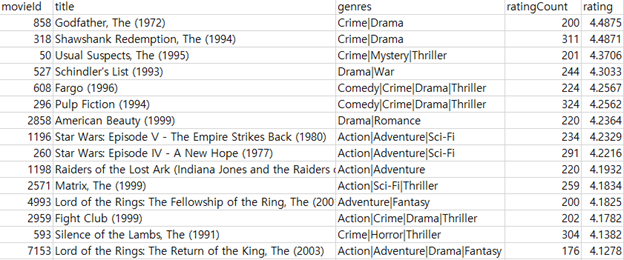
- Cold-start handling for new users via a popularity-based seed list with randomized ordering, so no two new users see an identical opener
- TF Serving in Docker as the inference layer, fronted by an AWS-hosted backend — model artifact is the deployable unit
- Automated retraining pipeline so newly-collected ratings refresh the served model without manual intervention
- Kotlin/Android client with skeleton-UI image loading and persistent poster URL caching
Implementation Highlights
- Cold-start strategy: chose randomized popularity ordering over real-time trending recomputation. Both options solve “new users seeing identical lists” — randomization is simpler, requires no streaming state, and is indistinguishable from trending at this dataset’s scale (~100k ratings, hundreds of users).
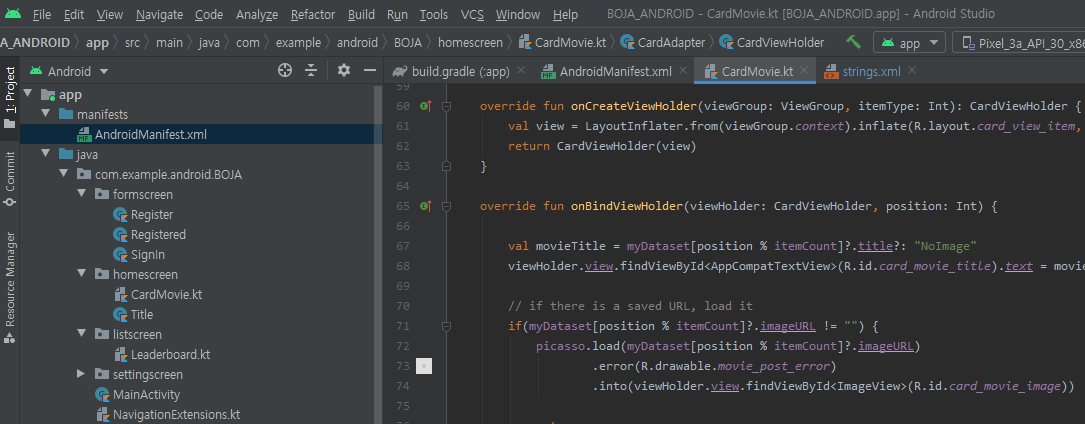
- Decoupled poster resolution: the recommender response carries only
(movie_id, title, genres). The client resolves posters via Bing Image Search and caches the URL plus accent color on theCardMoviemodel so repeat renders skip the network entirely (homescreen/CardMovie.kt,listscreen/Leaderboard.kt). A Gemini-style “single response, all assets inline” path was rejected to keep the inference response cheap and the image-loading concern out of TF Serving. - Server-side pagination on
/likedMoviesviastart/endrange parameters keeps client memory bounded as the user’s liked-movies grid grows (Leaderboard.kt). - TF Serving over a custom Flask wrapper: retraining becomes a swap-the-artifact operation rather than a code redeploy, and the gRPC/REST contract is fixed by the model signature.
Client (Android)
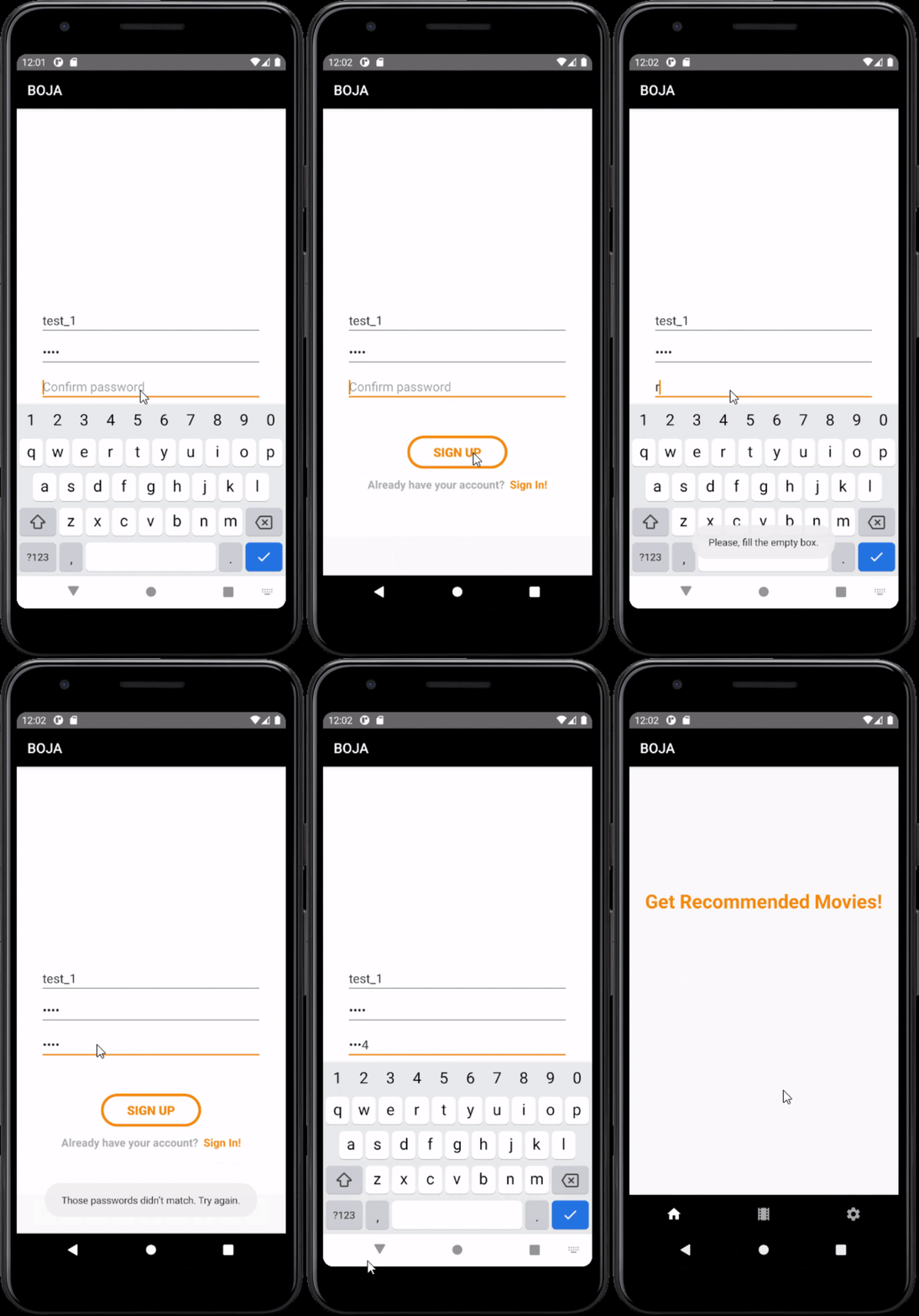
- Login & navigation stack — fragments managed via Android Navigation Component, with client/server validation covering blank fields, mismatched passwords, and unknown users.
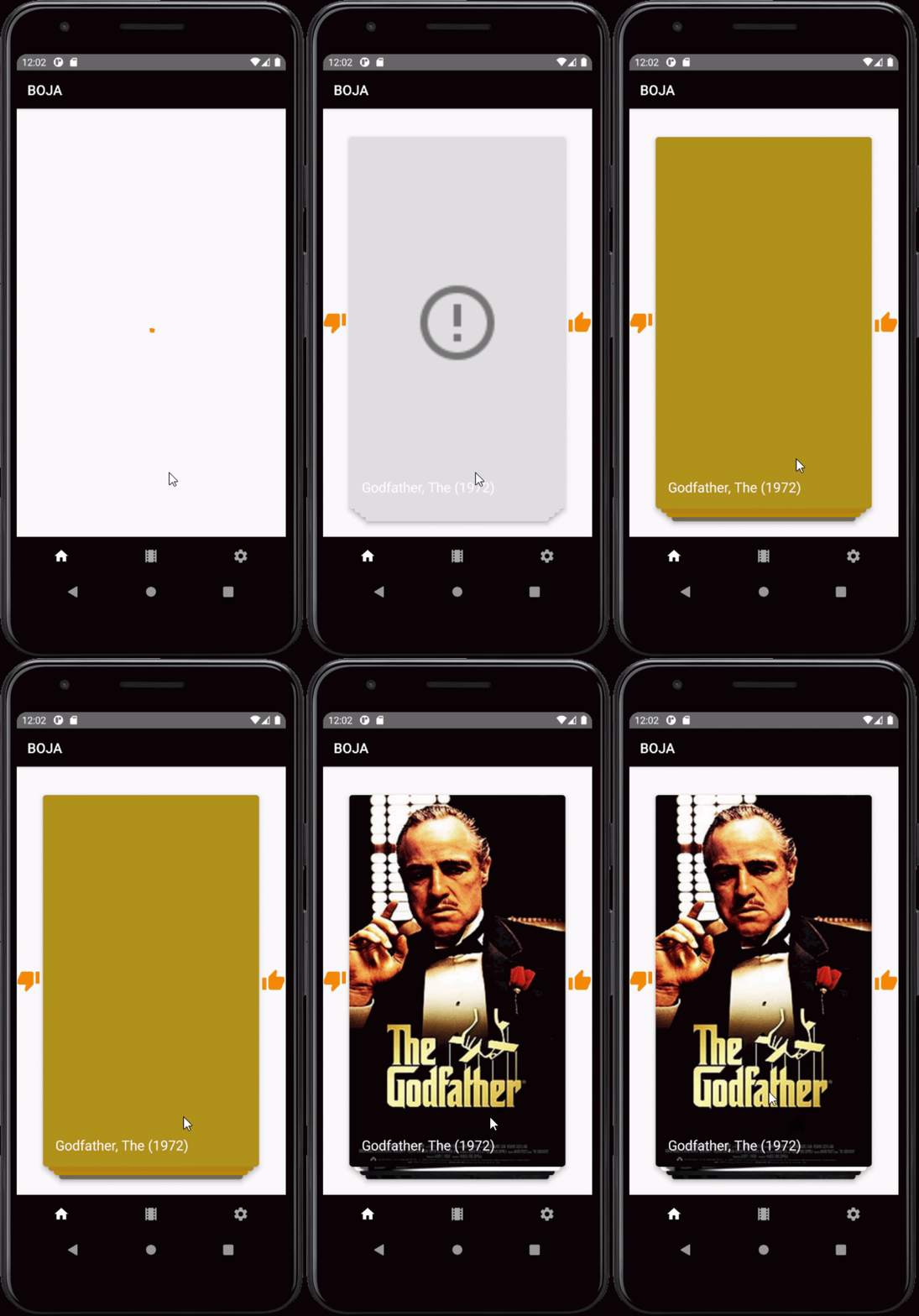
- Skeleton-UI image loading — three-stage render (title placeholder → accent-color background → full poster) gives users continuous visual feedback while Bing Image Search resolves and Picasso downloads/caches the poster.
- Card swiping + grid liked-movies — recommendations land on a swipeable card stack; confirmed likes appear in a paginated grid view.
Tech Stack
- Modeling: TensorFlow, TensorFlow Recommenders, Python
- Serving: TensorFlow Serving, Docker, AWS
- Data: MovieLens 100k ratings dataset
- Client: Kotlin, Android Navigation Component, Picasso, Fuel
- External APIs: Bing Image Search (poster lookup)